
The Toughest GED Social Studies Questions (and How to Solve Them)

The Toughest GED® Social Studies Questions (and How to Solve Them)
The GED® Social Studies exam doesn’t have to be intimidating. This test is more about reading comprehension and reasoning than memorizing a bunch of facts. Learn about the toughest GED Social Studies questions and how to solve them below.
What makes a GED Social Studies question “tough?”
One major reason students can struggle with GED Social Studies questions is because it requires you to read dense (and often dry) texts or charts in a short amount of time. Also, instead of simple yes-or-no questions, students are also asked to answer if the text is biased or creates propaganda, which can be tricky to know.
Practice GED Social Studies questions (with step-by-step answers)
Below aren’t real GED Social Studies questions and answers, but are similar to problems many students find tough to answer.
Practice question #1: Making an inference from a historical passage
This is a passage from the Declaration of Independence:
“Nor have We been wanting in attentions to our British brethren. We have warned them from time to time of attempts by their legislature to extend an unwarrantable jurisdiction over us. We have reminded them of the circumstances of our emigration and settlement here. We have appealed to their native justice and magnanimity, and we have conjured them by the ties of our common kindred to disavow these usurpations, which, would inevitably interrupt our connections and correspondence.”
Question: What can the reader most reasonably infer from this information?
- The colonists are impatient and unwilling to put up with the king’s laws.
- The colonists tried many other things before declaring independence, all to no avail.
- The colonists feel no kinship with the king and Britain.
- The colonists find British rule magnanimous.
How to Solve It
Identify the key facts in the passage.
Ask what conclusion those facts support.
Eliminate answers that go beyond the evidence.
Choose the answer most directly supported by the passage.
Answer
The second answer is correct.
The passage has four statements in a row beginning with “We have” and goes on to explain different things the colonists tried before declaring independence that have not worked.
Practice question #2: Identifying bias or propaganda
A wartime poster says that anyone who disagrees with a policy is unpatriotic.
Question: Which answer best explains why this is propaganda?
- The poster is telling people what to do.
- The poster is appealing to people’s emotions.
- The poster is using emotional manipulation to force people to agree with the policy.
- The poster is informing people of a new policy.
How to solve it
Look for emotionally loaded language.
Ask whether the source is trying to inform or persuade unfairly.
Compare the language with more neutral, evidence-based wording.
Answer
The correct answer is the third one.
“Anyone who disagrees with a policy is unpatriotic” is a form of pressuring people to agree with something through emotional manipulation rather than balanced evidence.
Practice question #3: Interpreting a chart or table
Since the 19th century, many people have worked for equal rights for women. Much of this effort focused on suffrage, which is the right to vote. One of the greatest victories for advocates of women’s rights was ratification of the 19th Amendment to the U.S. Constitution in 1920. The 19th Amendment stated that “The right of citizens of the United States to vote shall not be denied or abridged by the United States or any State on account of sex.” However, the struggle for equality in other areas of society continued even after the 19th Amendment grated woman suffrage.
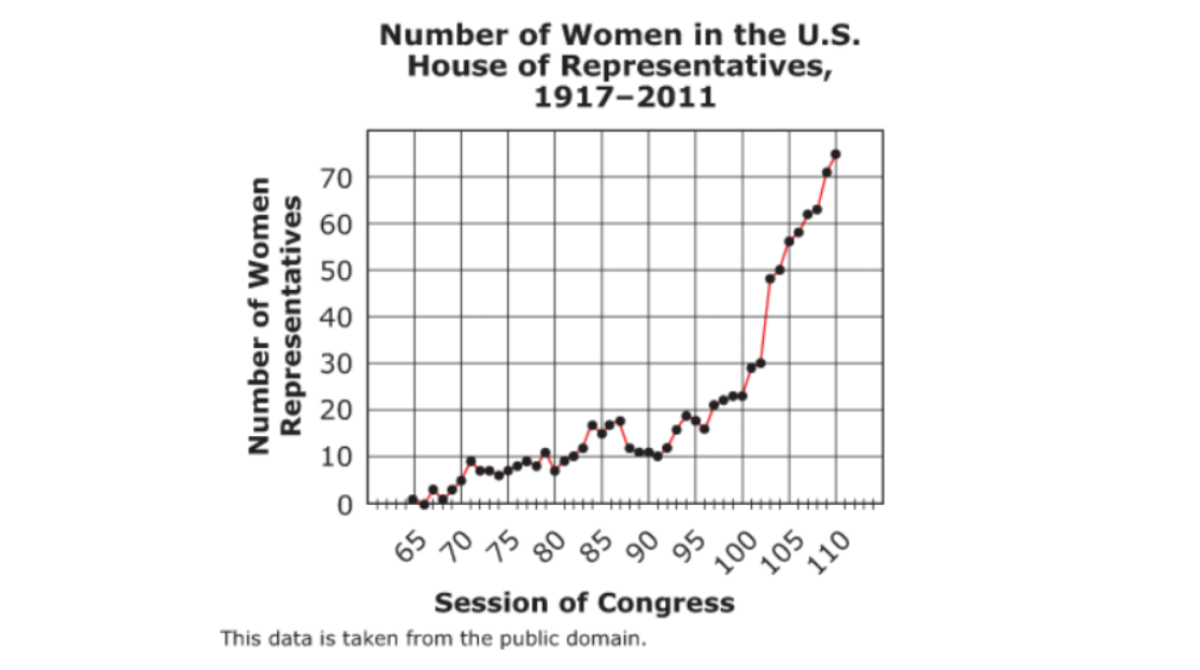
Question: What do the passage and graph indicate about the United States in the 20th and 21st centuries?
- Social movements halted inequalities within.
- The changes in voting rights impacted representation in the U.S. government.
- Democratic principles are more powerful than cultural traditions.
- The Civil War Amendments created greater democratic opportunities for women.
How to solve it
Read the title, labels, and time period.
Identify the biggest trend in the data.
Focus on what the graph proves, not implications.
Pick the answer supported by the chart and passage.
Answer
The correct answer is the second one.
The graph and passage focus on how changes in voting rights led to more women voting—which led to more female representatives. Neither the passage nor the graph discusses the Civil War, cultural values, or claims that inequalities no longer exist.
Practice more example questions, and take a look at our GED Study Guide for more information.
How many questions are on the GED Social Studies test?
There are about 35 questions on the GED Social Studies test, and they must be completed in 70 minutes or less.
Common mistakes on the hardest GED Social Studies questions
Here are the top six mistakes students make when taking the GED Social Studies test:
Reading too fast, leading to misunderstanding the context of the passage or even the question.
Skipping steps to finish on time.
Picking answers too quickly without considering the question.
Misreading graphs, leading to a misunderstanding of the information.
Not checking their work and catching mistakes.
Choosing answers that sound good but aren’t supported by the text/graph.
How to get better at GED Social Studies fast
Practice is the best way to get better at GED Social Studies. You can practice by:
Using practice tests: This will allow you to understand what kind of questions will be asked and what the correct answers are without pressure.
Studying the most challenging areas: If you struggle with a certain section, say interpreting graphs, take the extra time to focus on that area.
Retaking practice exams: Practice exams will often share your score and where you can improve. Use this information to improve your study plan.
Download our mobile app, GED & Me™: Work through practice questions, and work up an individual learning plan based on your GED Ready® Score Report.
Try GED Flash™: This paid tool has 1000s of interactive practice questions in both English and Spanish.
Use MyGED®: This provides you with GED resources on the go so you can study whenever and wherever you want. Sign up today!

GED+ All-inclusive prep program
Unlimited access to interactive tools, your own personal advisor, a test pass guarantee, and more!

Learn at your pace with GED Live online classes
Live and recorded classes will take you through every topic on the GED test and experts are available to answer questions.